

Every front-end styling dev can now speak the same language, rather than constructing their own from scratch.
Ok, but with Tailwind it seems that they are just saying p-4 uppercase instead of padding: 1rem; text-transform: uppercase; which is shorter, but exactly the same thing since it maps 1:1 to ‘custom’ CSS. It also doesn’t abstract away the CSS underneath, it just gives it a new name, which you have to learn in addition to the CSS
Tailwind compilers should only bring in the classes that you’re using, so it should be much smaller than almost any other framework.
In theory yes, but in practice look at the link in my original post for how it becomes slow with hot reloading in Vite. I don’t know if it would have the same problem with leptos, but probably yes, since it is an architectural flaw of generate the world, strip it down later.
DaisyUI is useful because it has helper classes
I do get DaisyUI, and it does fulfill the goal of getting devs to speak the same language. <button class="btn btn-primary"> totally makes sense. What I don’t get is why couple and build it on top of Tailwind which becomes useless at this point, since it’s just shorthand for some CSS. Maybe I am missing some big feature of Tailwind? Quoting the creator of Tailwind from the main page
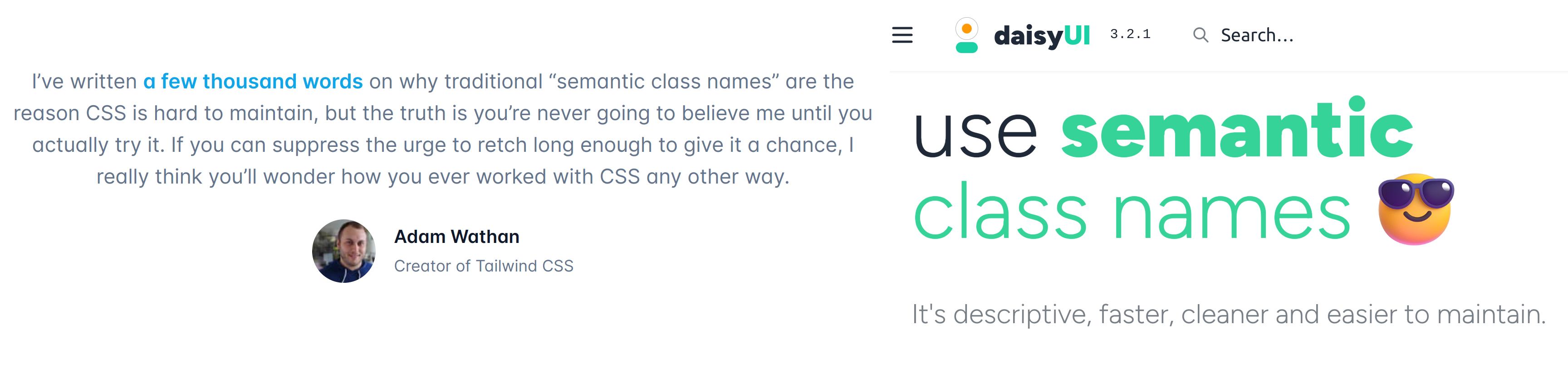
So he is clearly against the approach that DaisyUI advertises as a selling point.
https://github.com/unocss/unocss is the spiritual successor to windy. Some of the devs are the same